Venus: A Planet with a Longer Day than Year
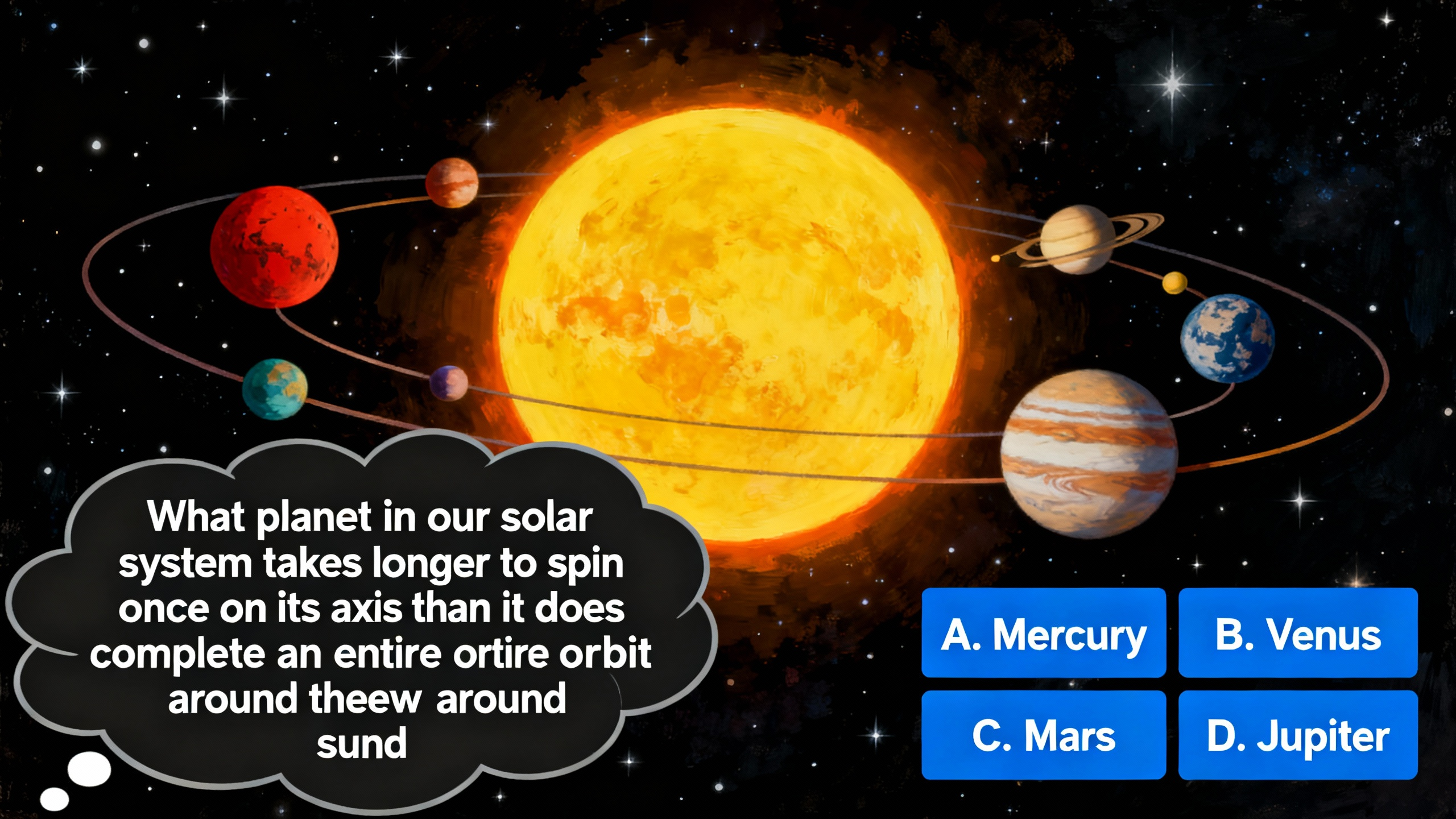
In the vast expanse of our solar system, each planet has its own set of unique characteristics that distinguish it from the others. Among these celestial bodies, Venus stands out as a truly remarkable planet. One of its most astonishing features is that it takes longer to spin once on its axis than it does to complete an entire orbit around the sun. This peculiarity defies our intuitive understanding of planetary motion and makes Venus a subject of great interest for astronomers and space enthusiasts alike.
Venus has an extremely slow axial rotation, which is quite unlike most other planets in our solar system. While planets like Earth rotate relatively quickly, completing a full rotation in just 24 hours, Venus takes its time. It rotates on its axis in a retrograde direction, which means it spins in the opposite direction compared to most other planets. If you were to stand on the surface of Venus and look up at the sky, you would see the sun rising in the west and setting in the east, a complete reversal of what we experience on Earth. A single rotation on Venus's axis takes about 243 Earth - days. This slow rotation is thought to be the result of various factors, perhaps including gravitational interactions with the sun and other planets during its formation and evolution.
To understand the possible reasons for Venus's slow and retrograde rotation, we need to delve into the early history of the solar system. During the formation of the planets, the solar nebula was a swirling disk of gas and dust. As the planets accreted from this material, they inherited their initial rotation from the angular momentum of the nebula. However, Venus may have experienced a significant impact event early in its history. A large asteroid or planetesimal could have collided with Venus, altering its rotation axis and causing it to spin in the opposite direction. Another theory suggests that the gravitational tug - of - war between Venus, the sun, and other planets over billions of years gradually changed its rotation. The sun's strong gravitational field could have exerted a torque on Venus, slowing down its rotation and eventually reversing it.
On the other hand, Venus orbits the sun at a relatively fast pace compared to its rotation. It takes approximately 225 Earth - days for Venus to complete one full orbit around the sun. This means that a day on Venus (defined as one rotation on its axis) is actually longer than its year (defined as one orbit around the sun). This unusual characteristic makes Venus a unique celestial body in our solar system, and it has significant implications for its climate and surface conditions. For example, the long days and nights contribute to extreme temperature variations on the planet's surface.
During the long Venusian day, which lasts for about 121.5 Earth - days, the sun beats down on one side of the planet continuously. The thick atmosphere of Venus, which is mainly composed of carbon dioxide, traps the sun's heat through the greenhouse effect. As a result, the surface temperature on the sun - facing side can reach up to 470 degrees Celsius (878 degrees Fahrenheit), hot enough to melt lead. This is much hotter than Mercury, even though Mercury is closer to the sun. The high temperature is due to the dense atmosphere of Venus, which acts like a thick blanket, preventing the heat from escaping back into space.
When the long night finally arrives on Venus, which also lasts for about 121.5 Earth - days, the lack of sunlight means that the surface starts to cool down. However, the thick atmosphere still retains a significant amount of heat, so the temperature drop is not as drastic as one might expect. The surface temperature during the night can still remain above 400 degrees Celsius (752 degrees Fahrenheit). These extreme temperature variations can cause thermal stress on the planet's surface rocks, leading to cracking and erosion over time.
The slow rotation of Venus also affects its weather patterns. On Earth, the rotation of the planet causes the Coriolis effect, which influences the direction of winds and the formation of weather systems such as hurricanes and cyclones. On Venus, the slow rotation means that the Coriolis effect is very weak. As a result, the winds on Venus are not as organized as those on Earth. Instead of large - scale weather systems, Venus has a global super - rotating atmosphere. The upper layers of the atmosphere can rotate around the planet in just four Earth - days, much faster than the planet's rotation. This super - rotation is still not fully understood, but it is thought to be related to the heating and cooling of the atmosphere by the sun and the interaction between the atmosphere and the planet's surface.
The unique characteristics of Venus also have implications for future space exploration. If humans were to ever send a mission to Venus, they would have to deal with the extreme temperatures, the thick atmosphere, and the long days and nights. For example, any spacecraft or rover sent to Venus would need to be designed to withstand the high temperatures and the corrosive effects of the atmosphere, which contains sulfuric acid clouds. The long days and nights would also pose challenges for power generation, as solar panels would be without sunlight for extended periods.
Despite these challenges, Venus remains an important target for scientific study. By studying Venus, we can learn more about the processes of planetary formation and evolution. Comparing Venus to Earth can also help us understand the factors that make a planet habitable. For example, both Venus and Earth are similar in size and mass, but their climates are vastly different. Understanding why Venus became a hot, inhospitable planet while Earth became a haven for life can provide valuable insights into the delicate balance of factors that determine a planet's habitability.
In conclusion, Venus's longer day than year is just one of the many fascinating aspects of this planet. Its slow and retrograde rotation, extreme temperature variations, unique weather patterns, and implications for space exploration all make it a subject of great scientific interest. As our technology continues to improve, we can expect to learn even more about this mysterious planet and unlock the secrets of its past and present.