Diamond Rain on Saturn and Jupiter
Our solar system is a vast expanse filled with countless wonders, and among the most captivating phenomena are the diamond rains that are believed to occur on Saturn and Jupiter. These two gas giants, located in the outer regions of our solar system, hold secrets that continue to fascinate scientists and space enthusiasts alike. The concept of diamond rain is not only a testament to the extreme and unique conditions present on these planets but also offers valuable insights into the complex processes that shape our cosmic neighborhood.
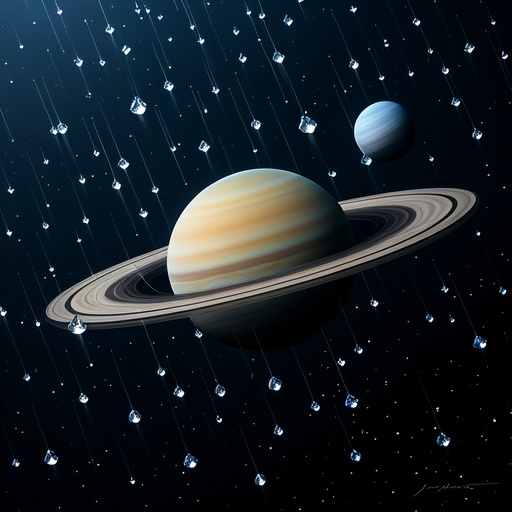
Saturn and Jupiter are colossal planets, with Jupiter being the largest in our solar system and Saturn following closely behind. Their massive sizes are accompanied by extremely thick atmospheres that are primarily composed of hydrogen and helium. These two elements make up the bulk of the atmospheres, giving the planets their characteristic gaseous appearance. However, it is the presence of trace amounts of other substances, such as methane, that sets the stage for the remarkable diamond rain phenomenon.
Methane, a simple hydrocarbon compound, plays a crucial role in the formation of diamonds on Saturn and Jupiter. In the upper layers of the planets' atmospheres, methane exists as a gas, just as it does on Earth. But as we venture deeper into these atmospheres, the conditions change dramatically. The pressure increases exponentially, and the temperature rises significantly. These extreme conditions are far beyond what we experience on our home planet, and they have a profound impact on the behavior of the methane molecules.
Under the intense pressure found deep within Saturn and Jupiter's atmospheres, the methane molecules begin to break apart. The carbon-hydrogen bonds in methane are relatively weak compared to the forces exerted by the high pressure. As a result, the carbon atoms are released from the methane molecules and are free to interact with each other. In this high-pressure environment, the carbon atoms start to bond together in a specific way, forming the crystal lattice structure that is characteristic of diamonds.
To understand this process better, let's take a closer look at the structure of a diamond. A diamond is made up of carbon atoms that are arranged in a three-dimensional lattice, with each carbon atom bonded to four other carbon atoms in a tetrahedral arrangement. This strong and stable structure gives diamonds their exceptional hardness and brilliance. On Saturn and Jupiter, the high pressure forces the carbon atoms to come together in this precise arrangement, creating tiny diamond particles.
Once these diamond particles form, they start to fall through the atmosphere, much like raindrops on Earth. However, the journey of these diamond particles is far from ordinary. As they descend deeper into the planet, they encounter even higher pressures and temperatures. The increasing temperature poses a significant challenge to the survival of the diamonds. At a certain depth, the temperature becomes so high that it can cause the diamonds to melt back into a liquid state.
Imagine a scenario where these diamonds, formed under extreme conditions, are on a one-way journey towards destruction. They start as tiny crystals, falling through the thick atmosphere, only to be melted away by the intense heat before they can reach the planet's core. This cycle of formation and destruction is a fascinating aspect of the diamond rain phenomenon and highlights the dynamic nature of these gas giants.
Scientists have been able to piece together the details of this diamond rain process through a combination of theoretical models and observations. Theoretical models are powerful tools that allow scientists to simulate the extreme conditions within the planets' atmospheres. By inputting data on the composition, pressure, and temperature of the atmospheres, these models can predict how the chemical reactions will occur and whether diamonds will form. These models have been refined over the years, taking into account the latest scientific knowledge and technological advancements.
In addition to theoretical models, observations from space probes and telescopes have also provided valuable insights into the atmospheres of Saturn and Jupiter. Space probes, such as the Voyager missions and the Cassini-Huygens mission, have flown by these planets, collecting data on their atmospheres, magnetic fields, and other characteristics. These missions have provided detailed information about the composition and structure of the atmospheres, which has helped scientists to validate their theoretical models.
Telescopes, both on the ground and in space, have also played a crucial role in studying these planets. By observing the light emitted and absorbed by the planets' atmospheres, scientists can determine the presence of different chemical compounds, including methane. These observations have confirmed the presence of methane in the atmospheres of Saturn and Jupiter, providing further evidence for the diamond rain hypothesis.
Although we cannot directly observe the diamond rain on Saturn and Jupiter, the scientific evidence strongly suggests that it occurs. The combination of theoretical models and observations has provided a compelling case for the existence of this phenomenon. However, there is still much that we don't know about the diamond rain process. For example, we are not entirely sure how large the diamond particles can get or how often the diamond rain occurs.
Future missions to Saturn and Jupiter could help to answer these questions. Scientists are planning to send more advanced space probes to these planets, equipped with state-of-the-art instruments that can provide more detailed information about their atmospheres. These missions could potentially detect the diamond particles directly or measure the chemical changes associated with the diamond rain process.
The discovery of diamond rain on Saturn and Jupiter has far-reaching implications for our understanding of the universe. It shows that the conditions necessary for the formation of diamonds can exist in places other than Earth. This has important implications for the search for extraterrestrial life, as diamonds could potentially play a role in the chemical processes that support life. Additionally, the study of diamond rain on these planets can help us to better understand the formation and evolution of gas giants, which are some of the most common types of planets in the universe.
In conclusion, the diamond rain on Saturn and Jupiter is a truly remarkable phenomenon that adds another layer of mystery and wonder to these massive planets. It is a testament to the extreme and unique conditions that exist in our solar system and offers valuable insights into the complex processes that shape our universe. As we continue to explore and study these planets, we can expect to learn even more about this fascinating phenomenon and the secrets that it holds.