The Illusion of Left - Right Reversal in Mirror Images
The phenomenon that mirror images seem to reverse left and right but not up and down is a fascinating and common perceptual illusion that has puzzled many people for ages. This illusion can be thoroughly explained from multiple perspectives, delving deep into the realms of physics, human perception, and cultural influences. 
To start with, it is of utmost importance to understand the fundamental nature of mirror reflection. A mirror operates based on the well - established law of reflection. According to this law, when a light ray strikes a mirror, the angle of incidence, which is the angle between the incoming light ray and the normal (a perpendicular line to the mirror's surface at the point of incidence), is exactly equal to the angle of reflection, which is the angle between the reflected light ray and the normal. This simple yet powerful law governs how all mirror reflections occur.
Let's take a more detailed look at what this means in practical terms. When you stand facing a mirror, the front - back direction is reversed. Imagine you are standing in front of a full - length mirror. If you have a watch on your left wrist, the watch appears on the left side of the mirror image as well. But here's where the confusion sets in. When you raise your right hand, the hand on the right side of the mirror image also moves. However, our minds have a natural tendency. We instinctively try to mentally "rotate" the mirror image to match our self - perception. We are so used to seeing other people in a normal, non - reflected context that we expect the mirror image to be a straightforward copy of ourselves. This mental rotation process leads us to feel that left and right are reversed.
For example, think about a scenario where you are wearing a T - shirt with a logo on it. When you look at yourself in the mirror, the logo appears to be reversed in a way that makes us think it's a left - right reversal. But in reality, it's because the front of our body is now facing the opposite direction in the mirror, causing the logo to seem flipped. 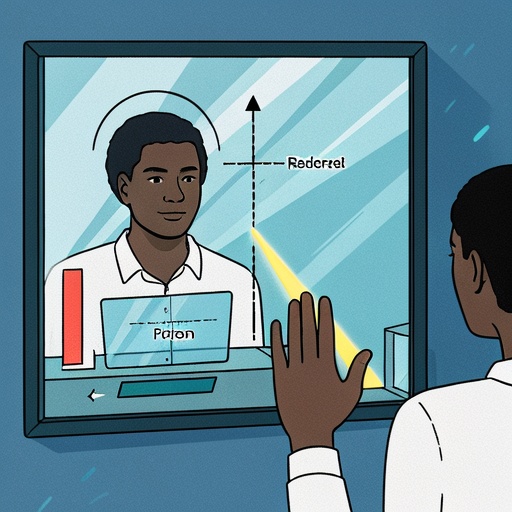
Our perception of left - right and up - down is intricately related to our body's symmetry and orientation. Humans possess bilateral symmetry, which means that our left and right sides are more or less mirror images of each other. This bilateral symmetry makes the left - right distinction far more prominent in our daily perception. We constantly use left and right to describe the relative positions of objects in a horizontal plane. For instance, when we give directions, we might say, "Turn left at the next intersection" or "The book is on your right - hand side."
In contrast, the up - down direction is defined by a more absolute reference: gravity. Gravity always pulls us downwards, and this creates a clear and consistent up - down axis. We know that the sky is up and the ground is down, and this perception is not easily confused. When we look at a mirror image, we compare it with our mental model of our own body. We have a very specific idea of how our body should look, and we expect the mirror image to be a direct copy. But because of the front - back reversal caused by the mirror, our brain struggles to reconcile this difference.
Let's consider a child who is just starting to understand the concept of mirrors. At first, they might be very confused by the mirror image. They might raise their hand and see the corresponding movement in the mirror, but they won't immediately understand why it seems so different from their normal perception. As they grow and start to develop a better understanding of their body's orientation and symmetry, they still fall prey to the left - right reversal illusion. This is because our body's symmetry and our learned way of perceiving the world around us make it difficult to break free from this misinterpretation.
Another significant factor contributing to this illusion is our cultural and linguistic background. We are deeply accustomed to using left - right terms in our daily communication to describe the orientation of objects and people. From a young age, we are taught to distinguish between left and right. In many cultures, there are even superstitions and symbolic meanings associated with left and right. For example, in some cultures, the left hand is considered unclean, while the right hand is used for more important or respectful actions.
This language - based perception reinforces the idea that the mirror reverses left and right. We use phrases like "left - handed" or "right - handed" all the time, and these concepts are deeply ingrained in our minds. When we look at a mirror image, we immediately apply these left - right concepts and assume that there is a reversal. In fact, if we were to define directions based on the mirror's reflection axis, we would realize that the so - called "left - right reversal" is just a misinterpretation of the front - back reversal.
Let's think about different languages. Some languages might have different ways of describing directions. For example, in some indigenous languages, directions are described based on natural landmarks or the position of the sun. If people from these cultures were to look at a mirror, they might not be as quick to assume a left - right reversal because their cultural and linguistic background doesn't place as much emphasis on the left - right distinction.
To further illustrate this point, consider a person who has a different body orientation. For example, someone who is lying on their side in front of a mirror. In this case, the normal up - down and left - right concepts are disrupted. The mirror still follows the same law of reflection, reversing the front - back direction. But our perception of what is left and right becomes even more muddled. We might find it even harder to make sense of the mirror image because our normal frame of reference is off.
In conclusion, the mirror doesn't actually reverse left and right. It's our perception, influenced by our body's symmetry, our learned orientation, and our cultural and linguistic background, that leads to this common misunderstanding. Understanding this illusion not only helps us see the world of mirrors in a new light but also gives us insights into how our brains process visual information and make sense of the world around us.
We can conduct some simple experiments to further prove this point. For instance, place a transparent sheet with a written word on it in front of a mirror. When you look at the reflection of the word in the mirror, it will seem reversed. But if you turn the sheet around and look at it directly, you'll notice that the so - called "reversal" is just a result of the front - back change. This shows that the left - right reversal is an illusion created by our perception and the way we interact with the mirror image.
As we continue to study and understand this phenomenon, we can also apply this knowledge in various fields. In art, for example, artists can use the concept of mirror reflection to create interesting visual effects. In science, understanding how our perception is affected by mirrors can help in the study of vision and cognitive psychology. So, the next time you look at yourself in the mirror, remember that what you're seeing is not a true left - right reversal but a fascinating interplay between physics and human perception.