To understand why iron rusts so readily while stainless steel remains corrosion-resistant, we must first dissect the electrochemical mechanisms of corrosion—a process where metals degrade due to reactions with their environment—and then explore how stainless steel’s alloy composition neutralizes this threat. We’ll then translate these principles into practical strategies for protecting everyday metal items.
 Why Iron Rusts: The Unstoppable Electrochemical Chain Reaction
Rust (formally hydrated iron(III) oxide, \(Fe_2O_3 \cdot nH_2O\)) is the product of a two-step electrochemical reaction that requires three key ingredients: iron, oxygen, and water. Here’s how it unfolds:
- Anodic reaction (iron dissolution): Iron atoms at the metal’s surface lose electrons, forming positively charged ions (\(Fe \rightarrow Fe^{2 + } + 2e^-\)). This happens at "anodic sites"—microscopic imperfections in the metal (e.g., scratches, impurities) where the lattice is weaker.
- Cathodic reaction (oxygen reduction): Oxygen from the air combines with water and the electrons released by iron to form hydroxide ions (\(O_2 + 2H_2O + 4e^- \rightarrow 4OH^-\)).
- Rust formation: The \(Fe^{2 + }\) ions react with \(OH^-\) to form ferrous hydroxide (\(Fe(OH)_2\)), which rapidly oxidizes to ferric hydroxide (\(Fe(OH)_3\)). Over time, this compound dehydrates into the flaky, porous rust we recognize.
Crucially, rust is non - protective: its loose structure doesn’t adhere to the underlying iron, so it peels away and exposes fresh metal to further corrosion. As corrosion experts M. G. Fontana and N. D. Greene note in their seminal textbook Corrosion: Principles and Practice, "Iron’s oxide layer is inherently defective—its volume is less than the metal it replaces, creating gaps that let oxygen and water reach the base metal." This is why unprotected iron (e.g., a cast - iron fence) will eventually disintegrate.
 Why Stainless Steel Resists Rust: The Power of the Passive Layer
Stainless steel owes its corrosion resistance to one key alloying element: chromium (Cr). By definition, stainless steel contains at least 10.5% chromium (per ASTM International standard A240/A240M), which rearranges the metal’s surface chemistry to form a passive oxide layer—a thin, invisible barrier that stops corrosion in its tracks.
When exposed to oxygen (even in trace amounts), chromium oxidizes faster than iron to form chromium(III) oxide (\(Cr_2O_3\)). This layer is:
- Impermeable: Just 1–10 nanometers thick (100,000 times thinner than a human hair), it blocks oxygen and water from reaching the underlying steel.
- Self - healing: If the layer is scratched (e.g., with a knife on stainless steel cookware), chromium atoms in the bulk steel immediately reoxidize to repair the damage.
- Adherent: Unlike rust, \(Cr_2O_3\) bonds tightly to the metal surface, so it never peels away.
As stainless steel specialists D. T. Llewellyn and W. J. Hudd explain in Stainless Steels: Microstructure and Properties, "The passive layer is the ‘magic’ behind stainless steel. Chromium shifts the metal’s corrosion potential to the passive region on the Pourbaix diagram—a chart that maps corrosion behavior based on pH and voltage—where oxidation stops." The Belgian chemist Marcel Pourbaix, who invented these diagrams, famously called this "the most important discovery in corrosion science."
 Beyond Chromium: How Other Alloys Boost Resistance
While chromium is the foundation, stainless steel often includes additional elements to enhance performance in harsh environments:
- Nickel (Ni): Adds to austenitic stainless steels (e.g., 304 - grade, which is 18% Cr + 8% Ni) to stabilize the metal’s crystal structure (austenite) and improve ductility. Nickel also strengthens the passive layer, making it more resistant to acids (e.g., tomato sauce in cookware).
- Molybdenum (Mo): Found in 316 - grade stainless steel (18% Cr + 10% Ni + 2–3% Mo), molybdenum targets pitting corrosion—a localized attack caused by chloride ions (e.g., seawater, salted roads). It forms molybdenum oxide (\(MoO_3\)) to block chloride penetration, making 316 ideal for marine equipment or outdoor grills.
These alloys work in synergy: chromium provides the passive layer, while nickel and molybdenum extend its durability in specific conditions.
 Applying Corrosion Principles to Protect Everyday Metals
The science of stainless steel teaches us two core strategies for protecting metals: create a barrier to block corrosive agents, or modify the metal’s chemistry to form a passive layer. Here’s how these principles translate to daily life:
A. Alloying: Sacrificial Anodes and Galvanization
Just as chromium protects stainless steel, zinc (Zn) protects galvanized steel—a common material for outdoor nails, gutters, and fencing. Zinc is more "electrochemically active" than iron (it has a lower corrosion potential), so it acts as a sacrificial anode: if the zinc coating is scratched, zinc corrodes instead of iron. As corrosion researcher H. Schikorr noted in Galvanized Steel: Corrosion Protection Mechanisms, "Zinc’s oxide layer (\(ZnO\)) is also protective, so even if the coating is thin, it buys years of service life."
B. Barrier Coatings: Paint, Epoxy, and Powder Coating
For metals that can’t be alloyed (e.g., cast iron, carbon steel), barrier coatings are the go - to solution. These include:
- Paint: Automotive paint uses a primer (with corrosion inhibitors like zinc chromate) and a topcoat to seal the metal from rain and salt.
- Epoxy: Used on tools and industrial equipment, epoxy forms a thick, chemical - resistant barrier against oils and solvents.
- Powder Coating: A dry powder (usually polyester or epoxy) is electrostatically applied to metal furniture or bike frames, then baked to form a hard, scratch - resistant layer.
Barrier coatings work because they separate the metal from oxygen and water—exactly what the passive layer does for stainless steel.
C. Cathodic Protection: For Large Structures
Cathodic protection (CP) is used for pipelines, ships, and water heaters—assets where replacing corroded parts is costly. It works by:
- Sacrificial anodes: Attaching zinc or magnesium blocks to the structure (e.g., a ship’s hull). These anodes corrode first, "donating" electrons to the metal and pushing its corrosion potential into the passive region.
- Impressed current: Using an external power supply to force electrons onto the metal, overriding the anodic reaction.
The National Association of Corrosion Engineers (NACE International) estimates that CP saves $30 billion annually in the U.S. alone by preventing pipeline leaks and ship hull failures.
D. Passivation: Enhancing Stainless Steel’s Layer
Even stainless steel can rust if its passive layer is contaminated—for example, if free iron particles (from cutting tools) are left on the surface. Passivation (per ASTM standard A967) solves this by soaking the metal in nitric acid (\(HNO_3\)) or citric acid. The acid removes free iron and accelerates chromium oxidation, creating a thicker, more uniform passive layer. This is why high - end stainless steel cookware is often passivated before sale.
 Practical Tips for Daily Life
To apply these principles at home:
- Stainless Steel: Avoid abrasive cleaners (e.g., steel wool) that scratch the passive layer. Use mild soap and a soft sponge instead.
- Galvanized Steel: Don’t sand or grind galvanized nails—this removes the zinc coating. For outdoor furniture, touch up scratches with zinc - rich paint.
- Cast Iron: Season it with oil to form a polymerized barrier (similar to a passive layer). The oil oxidizes to create a non - stick, corrosion - resistant surface.
 Conclusion
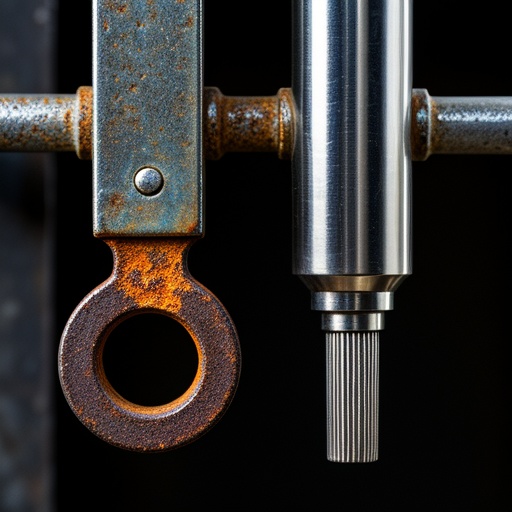
Iron rusts because its oxide layer is porous and non - protective, while stainless steel resists rust because chromium forms a self - healing passive layer. By mimicking this logic—either through alloying, coatings, or cathodic protection—we can protect nearly any metal from corrosion. The next time you use a stainless steel spoon or hang a galvanized fence, remember: you’re benefiting from a century of corrosion science, all focused on one goal—stopping the electrochemical chain reaction that turns strong metal into flaky rust.